WVELA19: Celebration, Disruption, & Vulnerability

When I found out the conference for WV English Educators was going to focus on inclusive classrooms, I wanted in! I submitted my proposal on Human Rights Ed and was accepted to present. Yay! After that initial excitement, my thoughts became filled with anxiety– What makes my classroom worth sharing? Who made me an expert? What can I offer other teachers? Who made me an expert? Could this work in other classrooms? Who made me an expert? (Impostor syndrome was hitting me REALLLLLY hard. But that’s something for another post).

Obligatory “This is what a presenter/teacher/activist looks like” picture.

The truth is, I saw a need in my classroom and sought resources to help my students. That’s how this journey into HRE began. Flash forward five years, and here I am, sharing tips, tricks, pedagogy, strategies, and resources with a room full of curious teachers, educators, and even community leaders. And it was AMAZING. Their ideas, their willingness to try these in their classrooms, and their vulnerability made the session a success.

But enough about me. At each session over the two days, I thought about how these new ideas, strategies, and resources could be incorporated into my own classroom. And that’s how the magic happens, right? When you see something at a conference, or online, or in a coworkers classroom, and you can’t wait to get back to your own students to try it out!

So here is my list of things I want to immediately bring back to my classroom:

Tricia Ebarvia got us thinking about identity, bias, and the canon. What a great way to kick off Day 2!
  1. #DisruptTexts – I’m pretty lucky, because in the middle school I teach at, I have autonomy over the books I chose and the units I plan. As long as I’m teaching the standards, I can get away with teaching YA Lit, classic lit, and even nontraditional media. But, am I doing enough to disrupt the canon? If I’m still choosing white authors, am I supporting my own biases? I’m excited to learn more from Tricia Ebarvia!

2. #TeachLivingPoets- Although I only caught half of the session, it really got me thinking about my past year of teaching Creative Writing to my 8th graders. I need to seek out contemporary authors, instead of relying on the poetry I used in college. If students can see living poets, people that experience the same world they do, maybe they will be more interested in writing poetry themselves!

Reader Identity & Tracking Reading shared by Joel Garza. The graphic is based upon Rudine Sims Bishop’s work. Check it out here.

3. Reader Identity- Joel Garza & Scott Bayer got me thinking about my own reading habits, my comfort zone, and my identity. I hadn’t ever thought of my reader identity until this session. And I got straight to work on this task! I’m going to become more dedicated to reflecting upon the books I chose, hopefully to find patterns, and to break out of my comfort zone. Everything I bring into my own reading is going to reflect back into the reading I ask my students to do. This session really hit home, especially because I’ve spent the past few months reading G.R.R. Martin’s Song of Ice and Fire series for the third time. I’m starting to think that this is kind of a selfish move! Yes, I want to write academic papers on a fantasy novel series I adore. But how is that helping my students? How is that affecting my teaching? And if I’m not actually writing a paper, then do I need to hang out in Westeros all the time? And reading something so comfortable & familiar isn’t going to help me grow as a person, a reader, or a teacher.

4. The last session I want to talk about was presented by Daniel Summers. His ideas on brainstorming & getting to students to ASK questions are things I want to incorporate into my own teaching practices. According to Summers, students are full of questions. But they are scared to ask them. And if we want them to write, we have to get them to ask great questions they can actually expand upon. I really struggle with implementing the brainstorm stage of the writing process. Brainstorming gets messy and noisy and isn’t easy for students. I love the idea of focusing on questioning in order to get students to a workable thesis. My favorite take away: “To know ____, you have to picture ____”.

So, to know WVELA19, you have to picture a room full of curious teachers, who love books & kids & writing & words & poetry & pronouns & Shakespeare & growth.

I can’t wait to see where the National Writing Project of WV & the WV Council for Teachers of English will take us next year. But you best believe I’ll be there with my ideas and questions.
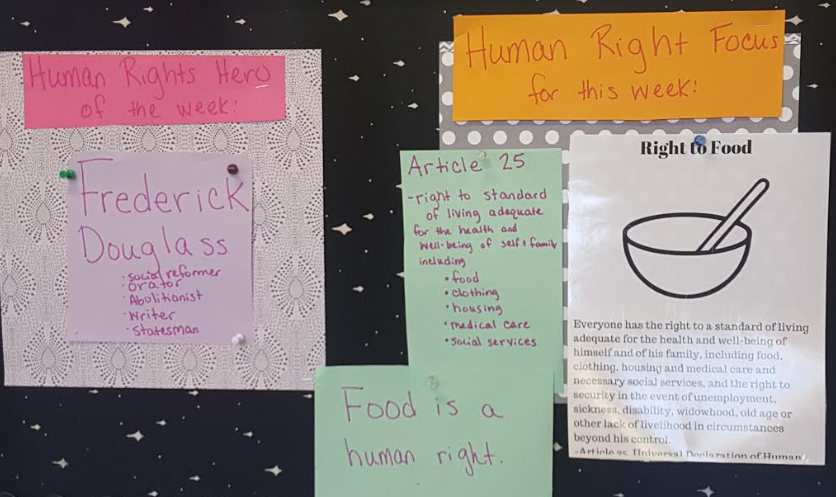
Food for Thought: Talking about Hunger & Food Insecurity with Teens

My classroom bulletin board for our “Food is a Human Right” week!

Frederick Douglass is one of my favorite 19th c. authors to teach. I adore the rich imagery, the extended metaphors, the insight into a world that is simultaneously foreign yet familiar. When my students and I read excerpts from his memoirs, they immediately notice two things: 1. He was brilliant & resilient 2. He was hungry, for both food and knowledge. A few years ago I found a beautiful student edition ebook that weaves together scenes from his life and excerpts of his writing. Students were drawn to one part in particular: the way food was used to control, manipulate, and dehumanize enslaved people.

Frederick included how he would fight with a dog for crumbs in his memoir My Bondage and My Freedom. One student asked after class, “How big were these crumbs? Like pieces of bread you’d give to a duck or the bottom of a bag of chips?”. We ultimately decided that it would be impossible to determine the size of the crumbs, but he chose the word crumb for a reason. And it was a conversation that showed me he was trying to process Frederick’s horrific experience.

The next day, students read about how children on the plantation where Frederick was enslaved were fed like pigs from a trough. I could see the shock and disgust on their faces. During our Think-Pair-Share time, emotionally charged conversations filled the room. Shouts of “Pigs are gross!” and “But they were just kids!” and even “I would have hit someone if they treated me like a stupid pig”, were followed up with a chance to write and reflect. One student, Avi*, wrote about how reading Frederick’s story made her want to cry– she has younger siblings and the idea of feeding herself and not them just seemed so impossible. How could she compete with them for food?

For Avi, it was personal. And if there is one goal for my English classes, it is to get kids thinking beyond the words on the text and finding personal connections. Furthermore, I want them to recognize that the atrocities experienced by Frederick Douglass, Harriet Tubman, and Nat Turner, haven’t completely gone away. We may have abolished slavery, but so many people in our own community feel dehumanized. And so many of these folks in our mountain town are struggling with food insecurity.

“If food is a basic human right, why are people starving?” and “Why aren’t we helping people get enough to eat?” were two of the major talking points brought up by students going into their final writing task. I asked students to simply write an essay responding to this statement: Food is a human right. I made the prompt broad, partly because I wanted to see how they would tackle something so abstract, something so serious, and also because every student enters my room with their own life experience. Without a doubt, there are students in my school who have experienced hunger, who have missed meals, or who have parents who sacrifice their own security & comfort to provide for them.

The writing was authentic- they researched world hunger statistics, issues surrounding food waste, the process of food going from fields & farms to supermarkets and eventually to their table, and even investigated the working conditions of workers in the food & farming industries. They discovered that 40% of the students in our own county’s public schools are food insecure. They researched the organizations and programs within our community that are working to make sure every person has enough to eat. And the final drafts of their essays? Incredible.

This concluding paragraph from Abra* says it all:

Hunger is a problem that many people have read about in history class or in textbooks but many people still experience it everyday. Throughout North America, Asia, Europe, and Africa, millions of people go on everyday with empty stomachs and hungry thoughts. Despite this being a right made by the United Nations, people are still not getting enough food to survive. In the next few decades countries have made it their mission to fight global starvation throughout the world. Buzz Aldrin once said “if we can conquer space then we can conquer childhood hunger.” Hopefully in the next few decades we can conquer this problem once and for all.

Talking about human rights can lead to heartfelt conversations. Human rights education can drive inquiry and call students to take action. And perhaps most importantly, it can provide us all with a little bit of empathy by asking us to walk a mile in someone else’s (possibly very hungry) shoes.

*Student name changed to protect privacy/identity*

Why Human Rights Education? It all goes back to “that” class.

When I started my teaching journey, I wasn’t naive about the realities many students face at home. Growing up in Appalachia, I’ve witnessed first hand the effects of multigenerational poverty, a landscape that is toxic to her people, the ways that heroin, alcohol, and opiates can tear families apart. But it wasn’t until my first year teaching middle school that I started to question if education was enough to combat the evils of the world.

My first “tough class”–you know, the one that keeps you counting down the minutes until its over, or the one that you can’t stop thinking about when you get home– was only 18 students. But those 18? They had each experienced adults who had let them down. And I was determined to not be another adult they could expect to brush them off.

Latisha*, one who struggled to read but was a brilliant artist, came into class wearing the same hoodie every day; her hair as unwashed as her clothes. Brad*, the only 15 year old eighth grader I’ve ever taught, could turn from kind to physically aggressive in a matter of minutes, only to crumble with regret after each altercation. I made a lot of mistakes in that first year of teaching. I thought that if I just “treated every kid the same” and ignored the extremes, I could give them all the best education possible. I thought that by ignoring the obvious pain that Latisha and Brad were in each day, I could get them to love literature and writing. I thought I could teach them to ignore their home lives.

But, you cannot ignore childhood hunger. You cannot ignore housing insecurity. And more importantly, as teachers, we can not ignore the fact that adults have let so many of “our kids” down. We must learn how to not repeat this cycle (and it’s okay if we stumble along the way!).

In grad school, we talked a lot about Maslow’s hierarchy of needs. If kids don’t have their basics needs met, they cannot learn. But we, as educators, cannot write off the learning of students who are being failed by the system simply because “they can’t access learning”. Perhaps he best course of action is to give students the power to fight for what they deserve. To level with them, letting them know that we see their pain, we feel their burdens. And maybe, we can lighten their load by carrying these burdens with them, for them.

So, as the cartoon at the top of this post shows, there are kids coming into our classrooms carrying the heavy weights of poverty or dehumanizing abuses. Don’t they deserve to know the truth? That all people are entitled a safe, secure life? Don’t we owe them that, at least? And can’t we give them the tools to fight back? They too, are worthy.

If I could go back to that first “tough class”, I would do everything in my power to teach them how to fight for their rights. Because treating them like everyone else didn’t do any of us any favors. I would teach them that there are names for what they are going through. And there are services, programs, tools, helpers, words to make sure they don’t have to endure these hardships alone. I would let them know that I see them, and I’m prepared to carry some of the weight for them. I would let them know they are worthy of love, of justice, and most importantly, humanity.

A Human Rights Educator is Born.

Looking back over the past five years of teaching, my priorities have certainly changed. I remember the frantic days of combing through literature textbooks, hoping to find content that would trick my students into reading. I would pour over the content standards, perplexed as to how I was supposed to teach clauses and verbals when my students struggled to identify nouns and verbs. Yet now, I spend more time crafting lessons that celebrate humanity than I do editing student essays or frantically searching for graphic organizers online. This is the world of 2019– a world that so desperately needs celebrations and human decency.

I didn’t realize that teaching students about their inherent, basic human rights was radical, until a day when another teacher confronted me in the hallway.

“Did you give Anna* a copy of the Universal Declaration of Human Rights?” she asked, not quite accusatory, but certainly not friendly.

My coworker stared at me, bewildered as to WHY I would possibly give that student a sheet of paper with which she used to call out her other teachers. I too was a little confused, more so as to what the big deal was. Aren’t we supposed to be encouraging students to find their voice? I realized in that uncomfortable moment in the hallway that this is exactly how we empower the next generation. We give them the words to confront injustices (even the perceived injustices of middle school); we give them experiences to help them understand that they are not alone, and that they to, can overcome what ever barriers are blocking their path.

Anna, the student who carried around the abbreviated copy of the Universal Declaration of Human Rights, is at the high school now. And one of her high school teachers reached out to me recently.

“You know, she talks about your class. And watching some video about women not having any rights”, my friend texted.

“Tell Anna I say hey. And tell her to raise a little hell for me” was all I could reply.

My bulletin board currently.
Students were tasked with researching activists. More on that next time!

Some people think adolescence is too young to start these conversations– that we should protect the innocence of our students and preserve whatever is left of their childhood. But at 13, my students are so filled with fear and frustration. Isn’t it a good thing to help them articulate their complex emotions?

Teaching human rights doesn’t have to be done in isolation. And in fact, it should be touched upon in all subject areas and modeled through civil discourse. But sometimes, students need to know that there is a name for what they are feeling or experiencing. And often, injustice is the key word. For Anna, the world wasn’t always fair or kind. And that piece of paper helped her find hope within the unjust.

*Name of student changed to protect her identity.